What Is the Darga Trope? Meaning, Sound, and Symbol
Darga (דַּרְגָּא) is a conjunctive cantillation mark in Hebrew Torah reading — a connecting accent, not a pause — whose name is Aramaic for "step" or "staircase." It joins its word to the word that follows and most often leads directly into the disjunctive Tevir, forming the classic Darga–Tevir pairing.
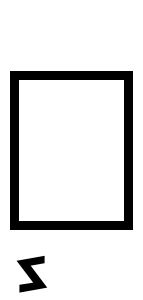
דַּרְגָּא
Conjunctive (connecting) accentWhat it does in the verse
Darga is a conjunctive (mesharet) accent, meaning it connects rather than separates: it binds its word to the word that comes after it and creates no pause in the verse. Because conjunctives serve disjunctives, Darga has no rank of its own in the disjunctive hierarchy — it simply leads the ear forward to the disjunctive it accompanies. Most characteristically it precedes a Tevir (the standard Darga–Tevir sequence, parallel to Munach–Etnachta or Mahpach–Pashta). It is also the conjunctive that always precedes a Mercha kefula, and it can appear as the earlier of two conjunctives leading toward a Revia (in that pair, the conjunctive immediately adjacent to the Revia is a Munach, with Darga the earlier of the two). Before a Tevir, Darga is chosen over Mercha when several syllables separate the conjunctive from the disjunctive; sources differ on the exact threshold (some say two or more syllables, others four, both words included).
What the symbol looks like
In TropeTrainer the Darga glyph appears below the consonant, on the stressed (accented) syllable of the word — for example ב֧. The symbol is an angular zigzag that resembles a backwards or mirrored Z, with sharp corners rather than a smooth curve, evoking its meaning of a descending "step" or staircase. Its sub-linear, below-the-letter placement is confirmed by the Unicode standard, where it is encoded as U+05A7 HEBREW ACCENT DARGA with canonical combining class 220 ("below"). Visually it can be confused with Munach, another below-the-line conjunctive whose simpler right-angle stroke lacks Darga's multiple bends.
Good to know
The name Darga comes from Aramaic for "step" or "degree" (related to madreiga), and both the angular, stair-step shape of the symbol and the descending melody mirror that meaning. It is a common accent throughout the Hebrew Bible — not a rarity like Shalshelet. Frequency figures reported by Wikipedia put Darga at roughly 1,091 occurrences in the Torah, 710 in Nevi'im (Prophets), and 637 in Ketuvim (Writings); the precise counts trace to that single source, but the qualitative point that Darga is common is well established. Its melody varies by tradition: Ashkenazic practice recites it as a fast downward slope, Sephardic tradition ascends, and Moroccan tradition descends with a waver in the middle. With TropeTrainer you can hear Darga chanted aloud in each tradition and practice the actual Torah readings where it appears, so you learn its connecting sound in real context rather than in isolation.
Frequently asked questions
What is the Darga trope?
Darga (דַּרְגָּא) is a conjunctive cantillation mark used in chanting the Torah. It is a connecting accent that joins its word to the following word, and it most often leads into the disjunctive Tevir in the well-known Darga–Tevir sequence.
What does Darga mean?
Darga is an Aramaic word meaning "step," "degree," or "staircase." Both its zigzag symbol and its typically descending melody echo this idea of stepping, and the name is related to the Hebrew madreiga.
Is Darga a pause?
No. Darga is a conjunctive (mesharet) accent, so it connects words rather than separating them. It creates no pause — instead it pushes the phrase forward toward the disjunctive accent that follows it, usually a Tevir.
What does the Darga symbol look like and where is it placed?
The Darga symbol is an angular zigzag resembling a backwards or mirrored Z, with sharp corners. It is placed below the consonant of the word's stressed syllable, which the Unicode standard confirms by encoding it (U+05A7) with the "below" combining class. It can be mistaken for the simpler Munach, which sits below the line with a plainer right-angle stroke.
How do you chant Darga?
Darga's melody depends on tradition: Ashkenazic reading uses a fast downward slope, Sephardic tradition ascends, and Moroccan tradition descends with a waver in the middle. TropeTrainer lets you hear Darga chanted and practice it within the Torah readings where it occurs.
Ready to start chanting?
Join thousands of students, cantors, and congregations who learn Torah with TropeTrainer.
© 2026 HazzanSolutions. All rights reserved.