What Is the Mercha Trope? Meaning, Sound, and Placement
Mercha (מֵרְכָא) is a conjunctive cantillation mark (trope) in the Torah that connects a word to the one after it, rather than signaling a pause. Its Aramaic name means "elongation" or "lengthener," because its melody prolongs and leads into the following word.
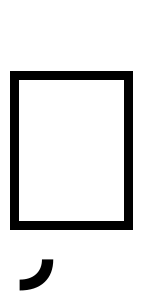
מֵרְכָא
Conjunctive (connecting) accentWhat it does in the verse
Mercha is a connecting (conjunctive, mesharet) accent, not a pausal one: it joins its word to whatever follows, much like a slur in music. It functions as a servant that leads into a following disjunctive (pausal) trope. It commonly precedes Tipcha and Sof Passuk and is documented leading into Munach Legarmeh, Pashta, Zarka, and Tevir. It belongs to both the Etnachta group and the Sof Passuk group of cantillation marks.
What the symbol looks like
Mercha appears as a small short oblique stroke (resembling a comma or a short leftward-leaning line) placed below the word's accented, or stressed, syllable, marking the primary stress. It is one of the "lower" accents, rendered beneath the letter. In Unicode it is encoded as U+05A5 HEBREW ACCENT MERKHA, a non-spacing combining mark whose canonical combining class is "Below" (220). TropeTrainer displays the actual glyph in context so you can see exactly where it sits on the word.
Good to know
Mercha is one of the most frequent trope marks in the entire Torah. According to Wikipedia it appears in the Torah 9,117 times, making it the second-most common trope after Tipcha (cited at 11,285). The same source gives per-book Torah counts of Genesis 2,415, Exodus 1,879, Leviticus 1,371, Numbers 1,859, and Deuteronomy 1,595, plus 7,672 occurrences in Nevi'im and 5,235 in Ketuvim; these figures trace to a single source and the per-book numbers sum slightly higher than the stated total, so they are best treated as approximate. Mercha was also known by the names Maarich (מַאֲרִיךְ) and Maarcha (מַאַרְכָא), and is transliterated Mercha, Merkha, or Meircha. It should not be confused with Mercha kefula ("double mercha," U+05A6), a distinct and far rarer mark. Like all the te'amim (cantillation accents), Mercha was developed by the Masoretes, with the Tiberian system reaching its standard form by roughly the 10th century CE (the Aleppo Codex dates to about 920 CE). With TropeTrainer you can hear Mercha chanted and practice the readings in which it appears.
Frequently asked questions
What is the Mercha trope?
Mercha is a conjunctive cantillation mark (trope) used in chanting the Torah. It connects its word to the following word instead of marking a pause, and it most often leads into a pausal trope such as Tipcha or Sof Passuk.
What does Mercha mean?
Mercha (מֵרְכָא) comes from an Aramaic word meaning 'elongation' or 'lengthener.' It is named this way because its melody prolongs and carries forward into the next word. It was also historically called Maarich or Maarcha.
Is Mercha a pause?
No. Mercha is a connecting (conjunctive) accent, not a pausal one. Rather than separating words, it joins its word to the one that follows, like a musical slur, and typically leads into a separating trope that does create the pause.
Where is Mercha placed on the word?
Mercha is placed below the accented (stressed) syllable of its word, reinforcing the primary stress. It is one of the 'lower' cantillation accents and appears as a short oblique stroke beneath the letter. TropeTrainer shows the glyph in context so you can see and hear exactly how it is used.
Ready to start chanting?
Join thousands of students, cantors, and congregations who learn Torah with TropeTrainer.
© 2026 HazzanSolutions. All rights reserved.