What Is the Mercha Kefula Trope?
Mercha Kefula (מֵרְכָא כְּפוּלָה), meaning "double mercha," is one of the rarest cantillation marks (te'amim, or trope) used to chant the Hebrew Bible. Its name comes from its shape, which looks like two mercha symbols joined together, and it is most commonly treated as a conjunctive accent that connects words within a verse.
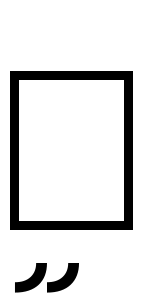
מֵרְכָא כְּפוּלָה (Merkha Kefula)
Conjunctive (connecting) accentWhat it does in the verse
Mercha Kefula is most commonly described as a conjunctive (connecting) accent, paralleling the single mercha, which is conjunctive: rather than marking a pause, it binds its word to what follows in the phrase. Its classification is genuinely disputed, however. Some authorities treat it as another conjunctive, while others regard it as an occasional disjunctive that stands in for tevir, giving it a more pause-like role in those instances. Available sources group it among the rarer accents but differ on its exact placement in the cantillation hierarchy, so it is best understood as primarily conjunctive with a documented scholarly debate around its function.
What the symbol looks like
The glyph (shown above in TropeTrainer) resembles two adjacent merchas joined together, essentially a doubled version of the single mercha's short downward, right-leaning stroke. Its authoritative placement is below the letter of the stressed syllable: Unicode encodes it as U+05A6 with combining class "Below (220)," matching the sublinear single mercha. Some fonts and printed tables render the mark above the consonant instead, but this is a font and glyph rendering artifact rather than a competing scholarly position; the standard placement is below the word.
Good to know
Mercha Kefula is famous for its rarity. It occurs exactly five times in the entire Torah: Genesis 27:25, Exodus 5:15, Leviticus 10:1, Numbers 14:3, and Numbers 32:42 (once each in Genesis, Exodus, and Leviticus, and twice in Numbers). It also appears once in a prophetic Haftarah reading at Zechariah 3:2, which is read for Parashat Behaalotecha and for Shabbat Chanukah. Across the whole Hebrew Bible, Wikipedia cites a total of roughly 14 occurrences, though the source's own by-section breakdown (Torah 5 / Nevi'im 3 / Ketuvim 4) sums to only 12, so the overall count should be treated as approximate and unverified. The mark carries other regional names as well: the Sephardi tradition calls it Tere taame (תְּרֵי טַעֲמֵי, "two ta'amim") and the Italian tradition Teren chutrin (תְּרֵין חוּטְרִין, "two staffs"). It was added to Unicode in version 2.0 (July 1996) as "HEBREW ACCENT MERKHA KEFULA," category Nonspacing Mark. One scholarly conjecture, attributed to Dr. David Weisberg and reported by a single source, proposes that the mark flags words alluding to an aggadic (legendary or midrashic) tale, citing the Talmudic legend behind Zechariah 3:2; this remains an unconfirmed theory rather than established fact. In TropeTrainer you can hear Mercha Kefula chanted aloud and practice the readings it appears in.
Frequently asked questions
What is the Mercha Kefula trope?
Mercha Kefula (מֵרְכָא כְּפוּלָה) is one of the rarest Hebrew cantillation marks (te'amim, or trope) used to chant the Torah and Haftarah. Its name means "double mercha," and it is most commonly treated as a conjunctive accent that connects words within a verse.
What does Mercha Kefula mean?
The Hebrew name מֵרְכָא כְּפוּלָה literally means "double mercha." It is named for its shape, which looks like two single mercha marks joined together. In Sephardi tradition it is called Tere taame ("two ta'amim") and in Italian tradition Teren chutrin ("two staffs").
Is Mercha Kefula a pause?
Most commonly, no. Mercha Kefula is generally described as a conjunctive (connecting) accent, meaning it binds its word to what follows rather than marking a pause. Its classification is disputed, though: some authorities treat it as an occasional disjunctive substitute for tevir, which would give it a more pause-like role in those cases.
How rare is Mercha Kefula and where does it appear?
It is one of the rarest cantillation marks. It occurs exactly five times in the Torah (Genesis 27:25, Exodus 5:15, Leviticus 10:1, Numbers 14:3, and Numbers 32:42) and once in the Haftarah at Zechariah 3:2, read for Parashat Behaalotecha and Shabbat Chanukah.
Ready to start chanting?
Join thousands of students, cantors, and congregations who learn Torah with TropeTrainer.
© 2026 HazzanSolutions. All rights reserved.