What Is the Revia Trope?
Revia is a disjunctive (pausal) cantillation mark in the Torah and other Hebrew Bible texts. It signals a medium-strength stop—stronger than Pashta or Tevir but weaker than Zakef or Tifcha—dividing a verse into smaller phrases as it is chanted.
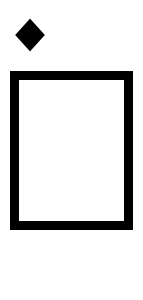
רְבִיעַ (Revia)
Disjunctive (pausal) accentWhat it does in the verse
Revia is a disjunctive ta'am, meaning it separates rather than connects words. It marks a pause of medium strength: it breaks a phrase more firmly than Pashta or Tevir, but yields to the stronger Zakef and Tifcha. Functionally it helps subdivide the larger segments of a verse, dividing the quarters of a verse in half again. Revia often substitutes for Pashta when a stronger break is needed (for example, to avoid a run of consecutive Pashtas), though the stop immediately before a Zakef always remains a Pashta. Depending on its position in the verse it may itself be replaced by other disjunctives: zarka near a segol, pashta or yetiv near a zakef, and tevir near a tifcha. Its conjunctive servants are Munach and Darga in an alternating pattern (the nearest is always Munach, then Darga, then Munach), and it is commonly preceded by Munach Legarmeh or Geresh.
What the symbol looks like
Revia is written above the word, over its stressed syllable. In printed and typeset texts it appears as a small diamond-shaped mark; in older manuscripts it is simply a single dot above the letter. Its Unicode character is U+0597 HEBREW ACCENT REVIA, shown here on a sample letter: ב֗.
Good to know
Revia is one of the everyday cantillation marks rather than a rarity: it occurs roughly 2,430 times in the Torah, 2,239 times in Nevi'im (Prophets), and 1,672 times in Ketuvim (Writings), making it a frequent companion to the more familiar stops. In Wikipedia's schematic hierarchy of disjunctives—Emperors, Kings, Dukes, and Counts—Revia is the usual third-level disjunctive, a "Duke." Its name is usually explained as Aramaic for "fourth" or "quarter" (revi'i), which is why Ashkenazim sometimes call it "Revi'i" by folk etymology; however, that quartering explanation is likely folk etymology, and the name more plausibly means "crouching" or "lying," a reference to the way the mark rests vertically above the word. In the Ashkenazi tradition described by Wikipedia, its melody is read in a slow, downward tone with a pause in the middle that breaks upward. Unlike the famously rare Shalshelet, which appears only a handful of times in the Torah, Revia carries no "appears only N times" rarity claim—it is part of the everyday vocabulary of trope.
Frequently asked questions
What is the Revia trope?
Revia is a disjunctive (pausal) cantillation mark used in chanting the Torah and other books of the Hebrew Bible. It marks a medium-strength pause that divides a verse into smaller phrases.
What does Revia mean?
The name is usually said to come from Aramaic for 'fourth' or 'quarter' (revi'i), which is why some Ashkenazim call it 'Revi'i.' That explanation is probably folk etymology, though; the name more likely means 'crouching' or 'lying,' describing how the mark rests above the word.
Is Revia a pause?
Yes. Revia is a disjunctive accent, so it signals a stop rather than connecting words. It is a medium-strength pause—stronger than Pashta or Tevir, but weaker than Zakef or Tifcha.
What does the Revia symbol look like and where does it go?
Revia is a diamond-shaped mark in printed texts (a single dot in manuscripts), placed above the word over its stressed syllable. Its Unicode character is U+0597.
Ready to start chanting?
Join thousands of students, cantors, and congregations who learn Torah with TropeTrainer.
© 2026 HazzanSolutions. All rights reserved.