What Is the Tipcha Trope?
Tipcha (Hebrew טִפְחָא; also called Tarcha in Sephardic and Oriental traditions) is a disjunctive Torah trope, or cantillation accent, that marks a meaningful pause within a verse. It is a second-level "Kings" disjunctive, ranking just below the major pauses of etnachta and sof pasuk, and it typically signals the break that leads up to one of those stronger accents.
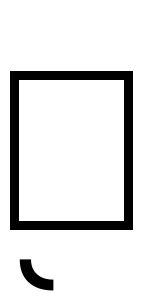
טִפְחָא (also written טִפְּחָא)
Disjunctive (pausal) accentWhat it does in the verse
Tipcha is a disjunctive (separating) accent, meaning it divides a verse rather than linking words together. It marks a significant but non-final clause break, most often appearing immediately before etnachta or sof pasuk to introduce the verse's mid-point or end. In the Masoretic accent hierarchy it sits at the second "Kings" level, subordinate to the first-order "Emperors" (silluq/sof pasuk and atnach/etnachta), and it commonly stands in where zaqef would otherwise fall when adjacent to those stronger accents. It is a stronger disjunctive than tevir and roughly comparable in pausal weight to zaqef. Tipcha belongs to both the etnachta group (as its second member) and the sof pasuk group, and the chanted melody differs slightly between those two contexts. Because it is a genuine disjunctive, pausal (full-vowel) forms can occur on a word carrying Tipcha.
What the symbol looks like
Tipcha is an infralinear mark: a short stroke or line placed below the letter, beneath the accented (stressed) syllable of the word. It is drawn as a small horizontal line that slants like a diagonal, sometimes with a slight upward or leftward curve. In Unicode it is encoded as U+0596 HEBREW ACCENT TIPEHA (◌֖), a nonspacing combining mark with combining class "Below," added in Unicode 2.0 (1996). TropeTrainer displays the glyph in context so you can see exactly where it sits under the word.
Good to know
Tipcha is widely regarded as the most common cantillation sound in the Torah and is reported to occur roughly 11,285 times across the Five Books, the only trope sound said to appear more than 10,000 times (these counts trace to Wikipedia/Grokipedia rather than a peer-reviewed concordance, so treat them as approximate). Fittingly, the very first word of the Torah, בְּרֵאשִׁ֖ית (Bereshit, Genesis 1:1), is chanted on a Tipcha. In Sephardic and Oriental traditions the accent is known as Tarcha, often glossed as "dragging" or "effort." Its name is commonly linked to the Hebrew sense of "diagonal" and to tefach (טפח), a handbreadth or palm measurement, though that accent-name etymology is popularly cited rather than firmly established. Like the rest of the te'amim, Tipcha is part of the Tiberian Masoretic accent system codified by the Masoretes in works such as the Diqduqe ha-Te'amim tradition.
Frequently asked questions
What is Tipcha?
Tipcha (טִפְחָא) is a Torah cantillation accent, or trope, used to chant the Hebrew Bible. It is a disjunctive accent that marks a pause within a verse and is one of the most frequently occurring trope sounds in the Torah.
What does Tipcha mean?
The name Tipcha is commonly connected to the Hebrew sense of "diagonal" and to tefach (טפח), a handbreadth or palm measurement, reflecting its small slanting shape; this etymology is widely repeated rather than definitively proven. In Sephardic and Oriental traditions the same accent is called Tarcha, usually glossed as "dragging" or "effort."
Is Tipcha a pause?
Yes. Tipcha is a disjunctive (separating) accent, so it signals a pause that breaks up a verse. It is a second-level "Kings" pause, weaker than the major stops of etnachta and sof pasuk but stronger than tevir, and it most often appears just before one of those stronger accents.
Where does the Tipcha symbol go?
The Tipcha mark is placed below the letter, beneath the stressed syllable of the word. It looks like a short diagonal stroke and is encoded in Unicode as U+0596 (◌֖). TropeTrainer shows the glyph in context and lets you hear it chanted.
Ready to start chanting?
Join thousands of students, cantors, and congregations who learn Torah with TropeTrainer.
© 2026 HazzanSolutions. All rights reserved.