Yerach ben Yomo
Yerach ben Yomo is one of the rarest Hebrew cantillation marks (te'amim), a conjunctive ("connecting") accent that joins its word to the one that follows. Its name means "day-old moon," after the small crescent-shaped stroke written beneath the word. In the entire Torah it appears just once, in Numbers 35:5.
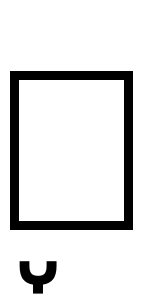
יֵרֶח בֶּן יוֹמוֹ (Yerach ben Yomo); also called גַּלְגַּל (Galgal)
Conjunctive (connecting) accentWhat it does in the verse
Yerach ben Yomo is a conjunctive (meshares, or "servant") accent, not a pause. Rather than breaking the verse, it binds its word tightly to the next, leading the voice forward without a stop. It serves the disjunctive Karne Parah (a Pazer-type accent), filling the connective role that Munach normally plays before a Pazer phrase — which is why it is often described as the "Munach" of a Karne Parah grouping. In Numbers 35:5 it links אַלְפַּ֪יִם (alpayim, "two thousand") to the following word, building the phrase "two thousand cubits."
What the symbol looks like
The symbol is a small crescent or curved stroke placed below the word, beneath the relevant letter — essentially an upside-down Etnachta, with its curve facing the opposite way. Its rounded, crescent-like shape gives rise to both its names: "day-old moon" (Yerach ben Yomo) and "wheel/circle" (Galgal). Its Unicode code point is U+05AA (HEBREW ACCENT YERAH BEN YOMO). It is meant to be drawn without the small bottom vertical tick that distinguishes U+05A2 (atnach hafukh), though many fonts render the two marks identically. TropeTrainer displays the glyph in context so you can see exactly how it sits beneath the word.
Good to know
Yerach ben Yomo is among the very rarest accents in the Hebrew Bible. It occurs exactly once in the whole Torah — Numbers 35:5 (parashat Mas'ei), on the word אַלְפַּ֪יִם (alpayim, "two thousand") — where it is immediately followed by the equally rare disjunctive Karne Parah on the next word, in the phrase "two thousand cubits." Karne Parah likewise appears only once in the Torah, at this same spot, making the Yerach ben Yomo + Karne Parah pairing the single rarest accentual configuration in the Pentateuch — rarer even than the famous Shalshelet, which occurs four times in the Torah. Across the full Hebrew Bible the Yerach ben Yomo + Karne Parah phrase occurs about 16 times total according to the Leningrad Codex, including once in the Book of Esther. Yerach ben Yomo belongs to the Tiberian Masoretic system of te'amim used for the twenty-one "prose" books, distinct from the separate poetic system of Psalms, Proverbs, and Job. TropeTrainer lets you hear Yerach ben Yomo chanted aloud and practice the reading it appears in, so you can master this once-in-the-Torah accent in its actual context.
Frequently asked questions
What is Yerach ben Yomo?
Yerach ben Yomo is one of the rarest Hebrew cantillation marks (te'amim). It is a conjunctive accent that connects its word to the one that follows, and it appears just once in the entire Torah, at Numbers 35:5. Its name means "day-old moon," referring to the small crescent-shaped stroke written below the word.
What does Yerach ben Yomo mean?
The Hebrew יֵרֶח בֶּן יוֹמוֹ literally describes a day-old, one-day crescent moon — a fitting name for the mark's small crescent shape. It also has an alternate name, Galgal (גַּלְגַּל), meaning "wheel" or "circle," likewise referring to its rounded form.
Is Yerach ben Yomo a pause?
No. Yerach ben Yomo is a conjunctive (connecting) accent, not a disjunctive pausal one. It binds its word to the following word rather than separating them. It is the disjunctive accent it serves — Karne Parah, which always appears right after it — that creates the break in the phrase.
How rare is Yerach ben Yomo?
Extremely rare. It appears only once in the whole Torah (Numbers 35:5), paired with the equally rare Karne Parah — making it the single rarest accent combination in the Pentateuch, rarer than the well-known Shalshelet. Across the full Hebrew Bible the pairing occurs about 16 times, including once in the Book of Esther. With TropeTrainer you can hear it chanted and practice the reading where it appears.
Ready to start chanting?
Join thousands of students, cantors, and congregations who learn Torah with TropeTrainer.
© 2026 HazzanSolutions. All rights reserved.