What Is the Zarka Trope?
Zarka is a disjunctive (pausal) cantillation mark in Torah reading whose Hebrew name means "throwing" or "scattering," reflecting its ornamental, scattered melodic motif. It is a third-level disjunctive that always appears just before a Segol, forming the standard Segol clause.
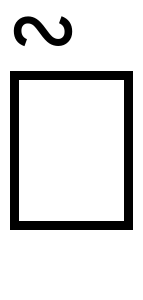
זַרְקָא (Zarka)
Disjunctive (pausal) accentWhat it does in the verse
Zarka is a disjunctive (pausal) accent, meaning it signals a break in the verse rather than a connection between words. It sits in the third level of the traditional four-tier hierarchy (the "Dukes" group, a didactic English label), and it functions as a substitute for the usual third-level disjunctive Revia when a Segol follows. Zarka only ever occurs before a Segol, where it builds the recognizable Segol group, typically chanted as [Munach] Zarka [Munach] Segol. As the sources put it, "Zarka is to the Segol what Pashta is to the Zakef katan and Tevir to the Tipcha."
What the symbol looks like
The Zarka symbol looks like a small curved, hooked squiggle, often described as a 90-degree-rotated, inverted "S" (זַרְקָא֮). It is postpositive, which means it is always placed at the end (left side) of the word, above and to the left, rather than over the stressed syllable. In Unicode it is encoded at U+05AE, where it carries the name "Hebrew Accent Zinor." TropeTrainer displays the actual glyph so you can match the mark you see in the text to the sound you hear.
Good to know
Zarka is a common, everyday accent, not a rarity: it appears 371 times in the Torah (Genesis 73, Exodus 80, Leviticus 56, Numbers 96, Deuteronomy 66), 186 times in Nevi'im (Prophets), and 182 times in Ketuvim (Writings) across the 21 prose books. That frequency stands in sharp contrast to a mark like Shalshelet, which appears only four times in the entire Torah. The melody varies by tradition: it is ascending in Moroccan and Sephardic practice and descending in the Ashkenazic tradition. On the three poetic books, Job, Proverbs, and Psalms, the equivalent mark goes by a different name, tsinnor, rather than zarka. With TropeTrainer you can hear Zarka chanted in your tradition and practice the actual readings where it appears, so the rule of "Zarka always leads into a Segol" becomes second nature rather than a fact to memorize.
Frequently asked questions
What is the Zarka trope?
Zarka is a disjunctive (pausal) cantillation mark used in chanting the Torah and other biblical books. It is a third-level disjunctive whose Hebrew name means "throwing" or "scattering," and it always appears right before a Segol, forming the standard Segol clause.
What does Zarka mean?
The Hebrew word זַרְקָא (Zarka) means "throwing" or "scatterer." The name reflects its ornamental, scattering melodic motif, a flourish of notes rather than a single sustained tone.
Is Zarka a pause?
Yes. Zarka is a disjunctive (pausal) accent, so it marks a break between words rather than joining them. It sits in the third level of the traditional hierarchy (the "Dukes" group), making it a moderate-strength pause that leads into the Segol that follows it.
Where does the Zarka symbol go on the word?
Zarka is postpositive: the mark is always placed at the end (left side) of the word, above and to the left, rather than over the stressed syllable. The symbol looks like a small hooked squiggle, often described as a 90-degree-rotated, inverted "S."
What is the difference between Zarka and tsinnor?
They are essentially the same mark under different names depending on the book. On the 21 prose books it is called zarka, and on the three poetic books (Job, Proverbs, and Psalms) the equivalent mark is named tsinnor. Both should be distinguished from tsinnorit, a separate conjunctive mark that shares a similar shape but is used to join words rather than separate them.
Ready to start chanting?
Join thousands of students, cantors, and congregations who learn Torah with TropeTrainer.
© 2026 HazzanSolutions. All rights reserved.